


Engines of Growth: New Report Reveals Bright Future for the UK’s Rural Communities
2 weeks ago • 1 min read
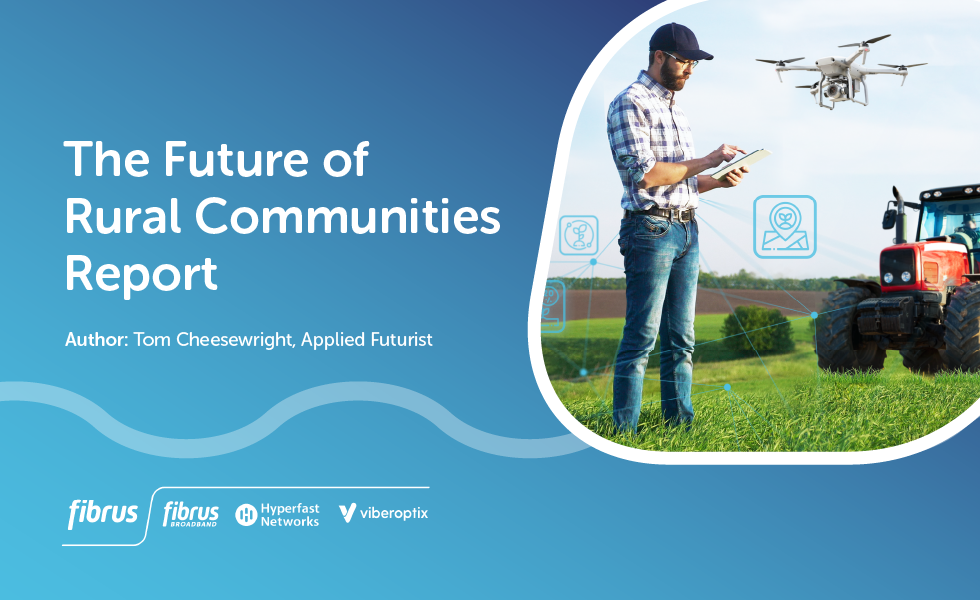
Fibrus has released a report which challenges long-held assumptions about rural decline and highlights the extraordinary potential of the UK’s rural communities as engines of growth.
The Future of Rural report, commissioned by Fibrus and authored by Applied Futurist, Tom Cheesewright, looks ahead to 2050 and uses scenario planning and the latest data projections to explore how rural areas can lead the way in economic, environmental, and social transformation.
Contrary to commonly held misconceptions, today’s rural communities are not shrinking but already thriving, with higher employment rates than urban areas and nearly a quarter of all UK businesses already headquartered in rural locations.
Fast-forward 25 years and the report outlines three predictions for how the UK’s rural areas might look in 2050:
- The Remote Revolution: While 2025 has seen reports of bosses demanding workers back to the office, the Future of Rural report has this as a temporary blip. By 2050, workers will have pushed for much greater flexibility to WFH. Advances in the metaverse digital infrastructure, AI and modern management techniques coupled with ubiquitous full fibre broadband will enable the shift back to remote working and a resurgence of rural lifestyles as the disadvantages of distance continue to diminish.
- High Tech Harvest: By 2050, the UK countryside could become ‘Silicon Valleys’, driven by a wave of new start-ups and clusters, spinning out of technology-focused agricultural educational institutions at the intersection of bio-science, robotics, energy and agriculture. Farming will become increasingly high-tech, with the use of human-scale androids, laser weeders and robot farm assistants piloted by smart glasses.
- Destination UK: As climate change alters global tourism patterns, the UK’s rural and coastal communities become sought-after destinations for visitors across Europe and America. AI powered translators and 3D avatar tour guides reshape tourist experiences, and artificial lakes and inland beaches give holidaymakers the quintessential beach holiday.
The report concludes that with targeted investment, particularly in connectivity and infrastructure, the UK’s rural communities can help address some of the nation’s biggest challenges, from demographic change to climate resilience.
Tom Cheesewright, author, said:
Many would be surprised at the extent to which the UK’s rural communities are already engines of growth. Even more would be surprised at their potential by 2050. With this report, we hope to inform and inspire, increasing the chance of these positive futures becoming reality.
Fibrus, established in 2019, is a vocal advocate of rural community growth. The company recently completed a £200million infrastructure project in Northern Ireland which was backed by the Department for the Economy, Department for Agriculture, Environment and Rural Affairs and the UK Government. Project Stratum, the largest telecoms infrastructural project ever seen in the region, was delivered on time and within budget this summer, changing the lives of those in rural communities by offering them the same opportunities as their urban counterparts. The region now boasts an impressive 95% connectivity rate compared to a UK average of 86% following the completion of this project.
More recently, the company has been lobbying Ofcom to review the cost to network providers for expanding networks in rural areas – something which would help bring much needed infrastructure to areas that remain without.
Dominic Kearns, CEO and Co-Founder, Fibrus, said:
At Fibrus, we set out to transform connectivity in rural areas, bringing them out of the digital dark ages and into a future of high-speed, reliable broadband. This report reinforces our commitment to those communities, highlighting their immense potential and the vital role they play in the UK’s growth.
Too often, the UK’s urban areas and capital cities dominate when it comes to policy, pounds and progress, yet we have seen first-hand the level of entrepreneurship and agricultural best practice that is powering the nation from a grassroots level through improved digital access. We will not stop championing rural communities and driving progress until every home and business is truly connected.
Fernando Auat Cheein, Professor of Agricultural Engineering, Harper Adams University (leading provider of higher education for the agricultural and rural sector) said:
The use of robots in various farming tasks is becoming increasingly common — not only in arable systems, where fully autonomous farms are already a reality, but also in horticulture, fruit handling, and other aspects of postharvest and food production.
As we move towards the future, the adoption of new technologies remains unresolved. They will require a new approach to training not only future specialists and farmers, but also the companies who will be providing technology to farmers.
The technology is fascinating, yet it is not yet developed to a point that aligns with the current education and skill levels of our stakeholders. As one partner once told me: “A robot is useless to me if I have to hire a postdoc to operate it.
This reflects the current reality: the level of sophistication of the technology limits its rapid adoption – and so we need careful planning to make these new futures a reality.
The full report is available to download here.
Share article
Recent Articles

Project Stratum reaches halfway mark with full fibre broadband roll out
3 years ago• 2 mins

7 Movies to watch this Halloween
3 years ago• 4 mins

Fibrus awards £55k to help address digital poverty
3 years ago• 2 mins

Why is rural internet slow and how can it be improved?
3 years ago• 4 mins